

SMEs: Low-carbon concrete, green steel and enhanced wood are becoming solutions for drastically reducing CO₂ emissions. The start-up Woodoo is proposing to replace aluminium, steel and concrete with lignin-free wood.
Post published on october 26, 2025 in Le Temps
By SERGE GUERTCHAKOFF (IMMOBILIER.CH)
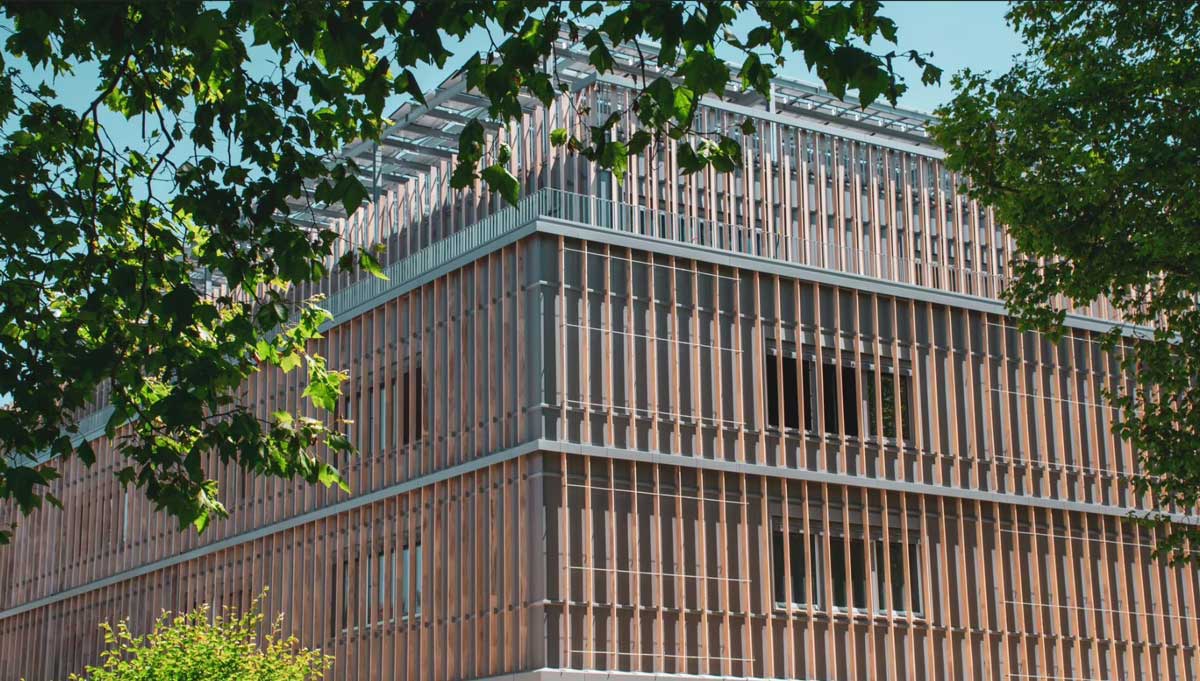
The company Woodoo has just announced the completion of the façade of the eco-friendly Mix-City building in Renens (VD). As it is intended for mixed use (logistics, workshops, offices, shops and leisure activities), its façade has been constructed using a new, innovative material called Stack enhanced wood. After around seven years of research and the filing of 82 patents, this enhanced wood is not only carbon-free, but also cheaper than traditional solutions such as aluminium façade panels. ‘The aim is not to replace standard wood when its characteristics are sufficient. Our mission for this new technology is to construct high-rise buildings that require high performance, enabling it to replace aluminium, steel and conventional concrete,’ says Timothée Boitouzet, 38, founder and CEO of Woodoo.
Trained architect
Among the many advantages of the solution developed by this French start-up is the fact that it can use low-quality, fast-growing wood such as poplar, which is abundant and undervalued. This wood is currently used mainly to make crates. Trained as an architect, Timothée Boitouzet specialised in earthquake-resistant wooden structures in Japan. ‘I’ve always felt that nature has designed wood very well. This material solves many problems.’ He had the opportunity to collaborate with architects Kengo Kuma, Herzog & de Meuron and Dominique Perrault.
‘I have always felt that nature has designed wood very well. This material solves many problems.’ TIMOTHÉE BOITOUZET, ARCHITECT
Passionate about wood and its performance, he gave up architecture to do research at the Massachusetts Institute of Technology (MIT) between 2010 and 2012. It was there that he discovered that by removing a molecule, wood could be transformed into a much more resistant material. Based on this discovery, he developed two products. One replaces the spikes on façades (sunshade systems), which are usually made of aluminium, and the other is used to make structural elements such as posts and beams.
Little competition
In addition to the façade material installed in Renens, Woodoo has signed a €32 million supply contract with Bouygues Construction for its structural product. The deal covers the production of 10,000 m3 for industrial buildings and data centres to be delivered over the next three years. “There is currently a real race to build data centres in Europe, particularly in France.
Our solution enables carbon-free and faster construction, as our beams are lighter than reinforced concrete beams [2.5 tonnes instead of 12 tonnes, editor’s note].” Woodoo’s production facility has been internalised in Troyes. ‘We are going to set up a Swiss structure within the next few months. We are still hesitating between the canton of Geneva and Valais. However, we intend to work with production partners,’ says the founder and CEO of Woodoo.
Green concrete
The young company raised €13 million from two Swiss family offices [including One Creation, a Swiss impact investment company based in Vevey], eight business angels – venture capital investors who operate on a smaller scale – and an American venture capital fund, Lowercarbon Capital. There are few competitors in the enhanced wood segment. One example is the American company InventWood, which hoped to start production of its product in 2025.
In addition to enhanced wood, which involves replacing lignin with a partially recycled resin that hardens in the pores of the wood, there is also low-carbon cement. In Switzerland, this currently refers to Hoffmann Green cement, which is produced using a manufacturing process with 0% clinker. Ultimately, its carbon footprint is reduced by a factor of 3.5. The first building containing 12 flats was constructed using this product in Grand-Saconnex (GE). The semi-underground ground floor is made of traditional concrete, while the three upper floors are made entirely of low-carbon concrete. The Maulini company has already used this concrete in the construction of several villas. Green steel is another example. As a general rule, this steel is more expensive than conventional steel, with a price premium of up to €300 per tonne. Here too, Switzerland is playing a pioneering role.
The new Forster campus in Romanshorn (Thurgau), designed by Ernst Fischer, was completed last year. It is the first complex in Switzerland to have been awarded LEED Gold certification, recognised for sustainable construction. Steel producers ArcelorMittal, Thyssenkrupp, SSAB and Voestalpine are combining different approaches to reduce CO2 emissions, from direct reduction using hydrogen to CO2 capture and storage. However, this requires the construction of very large factories. Woodoo says it is already ready to start manufacturing tens of thousands of cubic metres of enhanced wood, which will give it a head start over most of its competitors. In Switzerland, in addition to MixCity in Renens, Woodoo has three other projects in the pipeline: in Valais, Geneva and the Bernese Oberland. All of them involve façades. ‘The production of enhanced wood structures will only be available from 2026’, says the CEO.
